// CASE STUDY · MICHRAZIT
LIVE PLATFORM
Order in the jungle
of private construction.
A tender platform that brings order to one of the messiest processes in private home-building.
Michrazit needed a platform to replace the chaos of mismatched Word docs, WhatsApp reference-chasing, and hidden contract clauses — with a structured process: vetted suppliers, uniform bids, transparent comparison, and a clear path from project setup to signed contract.

- user types2homeowners · suppliers
- tender flow5digital stages
- vettingMULTIchecks before entry
- ratingDYNAMICperformance-based
// 01 · The problem
Building a private home in Israel is a jungle.
Dozens of suppliers, contractors, and consultants — each with their own format, pricing logic, and timeline. Homeowners compare Word documents that don't line up, chase references on WhatsApp, and sign contracts with hidden clauses they only notice later.
- 01
Formats that don't line up
Every supplier sends bids in a different shape. There's no honest way to compare.
- 02
WhatsApp references
Who actually worked with this supplier? How did it go? No way to know up front.
- 03
Hidden contract clauses
The big surprises show up after the signature — not before.
- 04
Once-in-a-lifetime decision
Most homeowners build once. They don't have time to learn the market.
// 02 · The platform
A two-sided platform.
Two products. One system.
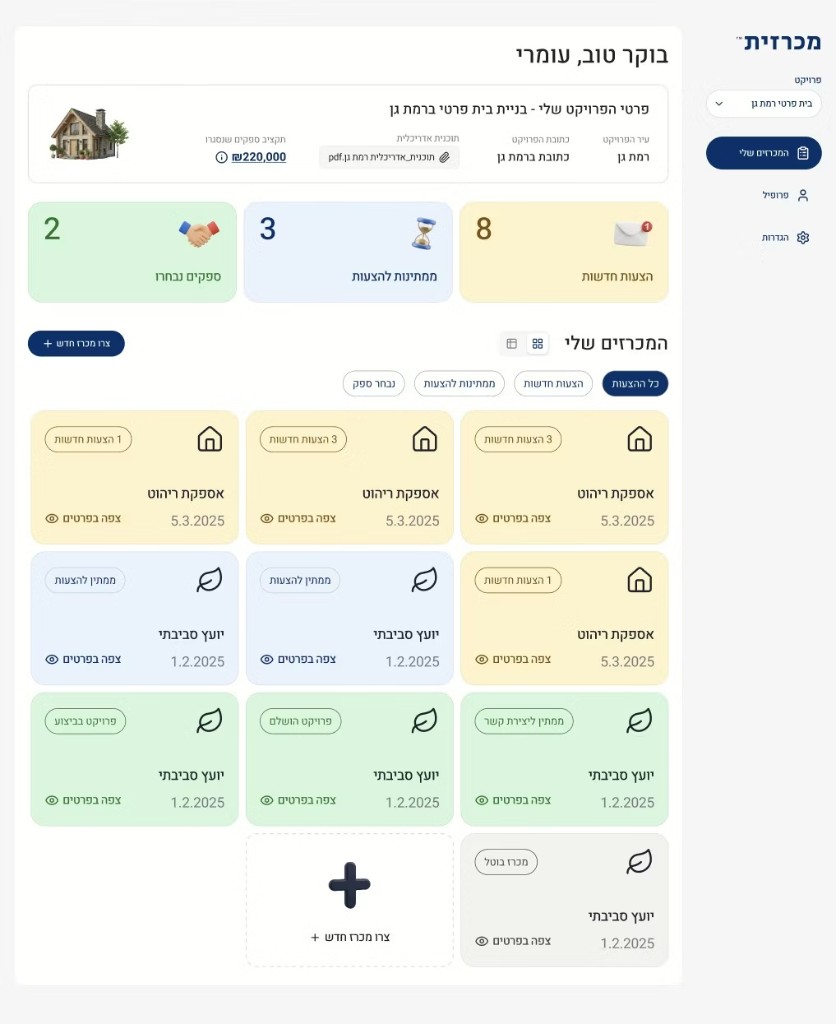
A workspace for project owners running a build, and a separate environment for suppliers receiving qualified leads. Each side with its own onboarding, dashboard, and tools — synced on the same backbone.
- 01Project owners
Homeowners
- 01Managed project setup
- 02Five-step digital tender
- 03Line-by-line transparent comparison
- 04Clear path to a signed contract
- 02Suppliers
Vetted suppliers
- 01Qualified leads only
- 02Bid submission in a uniform format
- 03Dynamic performance-based rating
- 04More exposure as quality grows
Every project. Every bid. Every status. In one place.
// 03 · What we built
The product, line by line.
- 01FEATURE · 01
Uniform-format bid comparison engine
Every supplier submits against the same spec, in the same structure, line against line. Homeowners compare apples to apples instead of decoding bids that don't speak the same language. Whatever locks in the tender — flows straight into the contract. No hidden clauses, no surprises.
- Uniform spec
- Line by line
- Locks to contract
- 02FEATURE · 02
Multi-step supplier vetting
Before a supplier joins the network they go through license checks, insurance verification, invoice verification from prior projects, structured deep-dive interviews with past clients, and operational-stability checks. If they don't clear the bar — they don't get in.
- Licenses
- Insurance
- Past invoices
- Client interviews
- Operational stability
- 03FEATURE · 03
Dynamic performance-based rating
A supplier's score isn't set at signup. It updates continuously based on response time, bid quality, on-time delivery, and customer satisfaction — and the score drives exposure in future tenders. That keeps the market honest over time.
- Response time
- Bid quality
- On-time delivery
- Customer satisfaction
// 04 · The tender flow
A digital tender flow,
in five stages.
Each stage carries a clear status, a clear next action, and the data behind it. No paperwork, no WhatsApp threads, no decisions getting lost.
STAGES
- 01
Project setup
Opening the project record: characteristics, address, budget, and planning docs.
- 02
Issue tender
The system generates a tender in the uniform spec and pushes it only to the suppliers that fit.
- 03
Collect bids
Suppliers submit in the same format. Each bid has a live status: pending, received, withdrawn.
- 04
Smart comparison
Line-by-line comparison view with flags on outliers and full price transparency.
- 05
Pick supplier
Whatever was locked — flows straight into the contract. No retyping, no clause leakage.
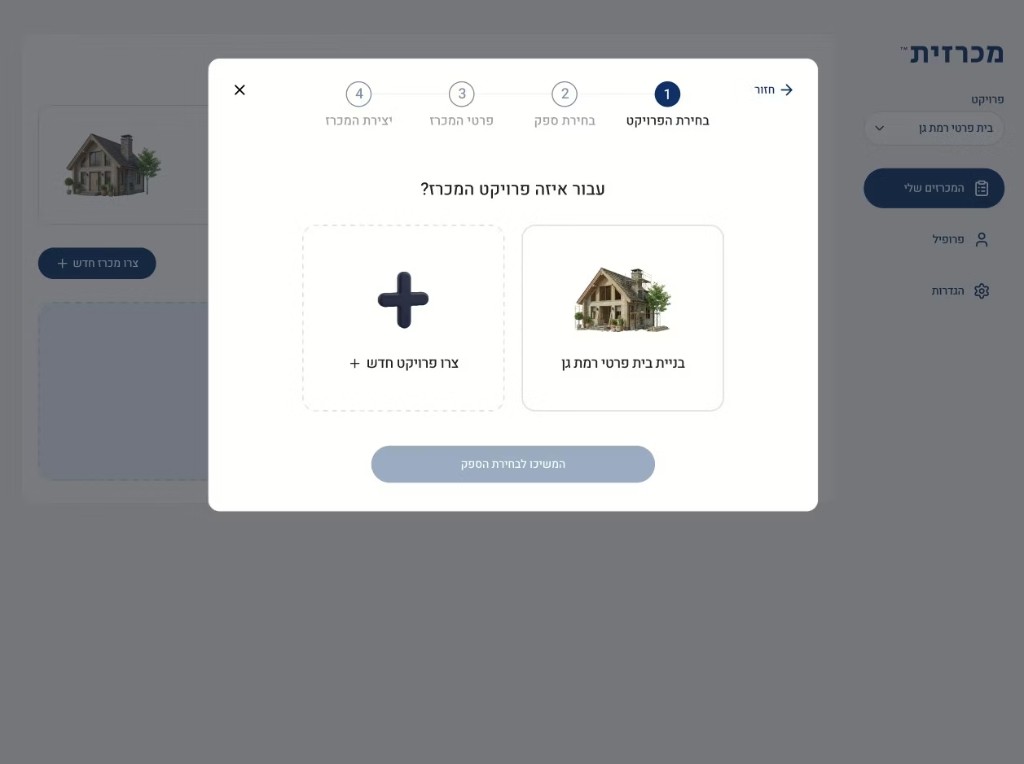
Inside the product · live stepper modal
// 05 · Matching by stage
The system knows the order trades come in.
The system detects whether the project is in planning, full construction, or renovation, and surfaces only the suppliers and categories that fit that exact stage. First-time builders don't need to know what comes first — the system orders the sequence.
- ARCH
- STRUCT
- ELEC
- PLUMB
- FINISH
- PAINT
// 06 · UX for non-experts
An interface that assumes zero prior knowledge.
Most homeowners build just once in their life. The product assumes zero prior knowledge of construction or supplier contracting — every screen tells the user where they are, what the next step is, and which decision they need to make right now.
- 01
Where am I in the flow
- 02
What's the next step
- 03
Which decision now
// 07 · The outcome
From scattered decisions —
to one process: transparent and measurable.
A platform that turns the private-construction tender process from a chain of disconnected decisions into a single, transparent, measurable flow — and gives homeowners the same level of control that used to live only in the contractors' hands.
- 01
Transparency
Every price, every line, every gap — out in the open.
- 02
Measurability
Every decision rests on data, not a gut feel.
- 03
Control
The homeowner runs the project — not the other way around.
// 08 · Technology
The stack behind the scenes
A modern stack chosen for the job — fast to build, stable in production, friendly to the user.
- Frontend
- React
- Next.js
- TypeScript
- UI
- Tailwind
- shadcn/ui
- Radix
- Backend
- Node.js
- NestJS
- REST
- Database
- PostgreSQL
- Prisma
- Redis
- Auth
- Auth0
- JWT
- RBAC
- Files & Docs
- S3
- PDF gen
- Word import
- Cloud
- AWS
- CloudFront
- RDS
- Observability
- Sentry
- Datadog
- Logflare
// 09 · Got a similar platform?
From chaos to a product.
That's what we do.
We built Michrazit from the first screen to the operational dashboard. If you have a business process that needs to become a real product, let's talk.
Platform. Process. Product.